


An AI agent is software that can take an action on its own reply to a customer, update a record, send a follow-up based on instructions you give it once, not a script you run every time. That’s the short version. The rest of this guide covers what that means in practice for a small business, what it costs, and how to tell if you’re actually ready for one.
Techhavell tests tools hands-on before writing about them. This guide won’t tell you AI agents are the future of everything. Some of them are genuinely useful. Some are overkill for a five-person shop. Both things are true, and this guide is here to help you tell which is which for your business.
What Is an AI Agent, Exactly?
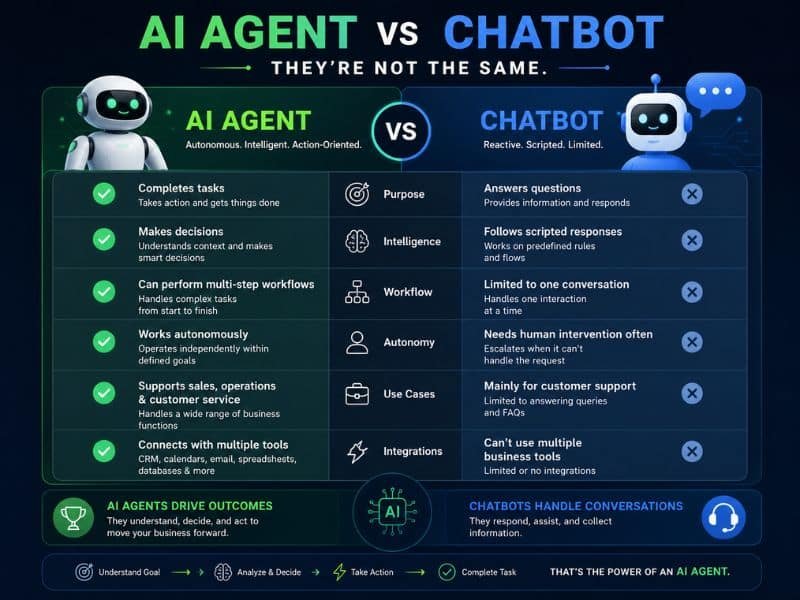
An AI agent is a program that can understand a goal, decide what steps to take, and carry those steps out without a human clicking “go” for each one. Give it a rule like “when a customer asks to reschedule, check the calendar and offer the next two open slots,” and it handles that conversation start to finish.
This is different from two things people often lump it in with:
- A chatbot answers questions from a script or a knowledge base. It talks; it usually doesn’t do anything beyond that.
- Automation (think Zapier or Make) moves data between apps on a fixed path: if X happens, do Y. It’s reliable, but it can’t handle a case the path didn’t anticipate.
An AI agent sits above both it can decide, within limits you set, how to handle a situation that isn’t identical to the last one. A full side-by-side lives in, but the table below covers the basics.
| Chatbot | Automation | AI Agent | |
|---|---|---|---|
| Can hold a conversation | Yes, scripted | No | Yes, adaptive |
| Can take action across systems | Rarely | Yes, fixed path | Yes, decides the path |
| Handles a case it wasn’t explicitly told about | No | No | Sometimes, within its guardrails |
| Needs ongoing manual triggering | No | No | No |
What Do Small Businesses Actually Use Them For?
The realistic use cases cluster around repetitive, rules-based work that still needs some judgment not fully creative or high-stakes decisions. Common starting points:
- Answering the same handful of customer questions (hours, order status, availability) any time of day
- Qualifying a lead before it reaches a person
- Booking and rescheduling appointments
- Chasing overdue invoices with a polite, consistent follow-up sequence
- Pulling a weekly performance summary from a few different tools into one report
A restaurant using one to handle reservation calls after hours looks nothing like an agency using one to draft a first-pass client report but the underlying pattern is the same: a well-defined, repeatable task that used to eat someone’s afternoon.
What Does an AI Agent Cost?
Pricing below is a general market range as of publish and needs a fact-check pass against current vendor pricing pages before this article goes live figures should not be treated as final.
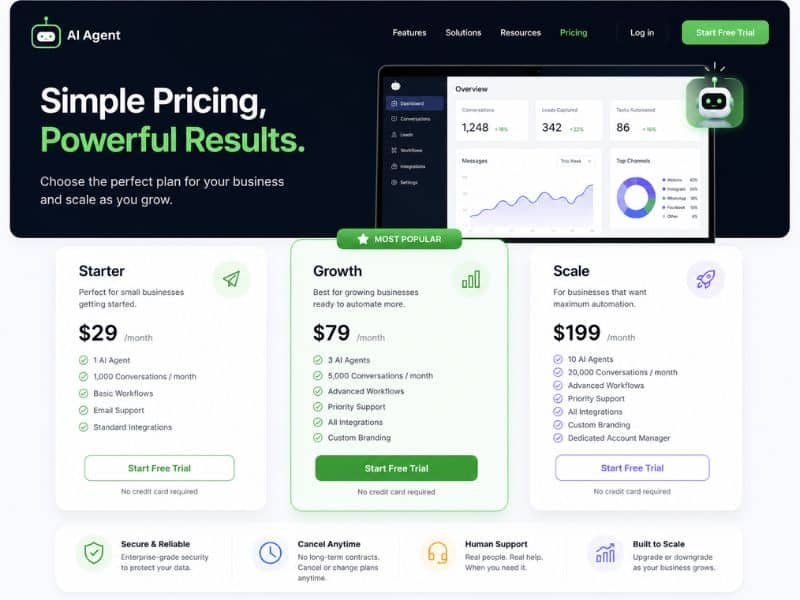
Most small-business-friendly AI agent platforms fall into one of three pricing shapes:
- Flat monthly seat/plan fee: a set price regardless of volume, common on entry-level plans
- Usage-based pricing: cost scales with conversations, tasks, or “runs” handled per month
- Hybrid: a base plan fee plus overage charges once you exceed an included volume
Entry-level plans for a single-agent setup tend to start in the tens of dollars per month; usage-based costs can climb quickly for a business handling high call or message volume, which is exactly where the hybrid model can produce bill shock if nobody’s watching the meter. Currency figures here are in USD; pricing may vary by region.
How Do I Know If My Business Is Ready?
Skip this if you’re still doing the task manually and it takes under ten minutes a day the setup time won’t pay for itself yet. It’s worth a serious look once a repetitive task is costing you real hours weekly, the task follows a pattern (even a fairly complex one), and getting it slightly wrong occasionally is an annoyance, not a disaster.
That last point matters more than most guides admit. An AI agent handling appointment scheduling that occasionally double-books is a minor headache. One handling a legal disclosure that gets it wrong is a different category of risk. Match the task’s error tolerance to how much autonomy you’re comfortable giving the agent.
Trust, Data, and Disclosure
Two questions come up constantly once a business starts using AI agents for customer-facing work: should customers know they’re talking to one, and where does their data go once the agent has it?
Neither has a single universal answer disclosure norms and data privacy rules vary by region (US state-level privacy laws differ from the UK/EU’s GDPR, for instance), so treat this as something to check for your specific market rather than assume. What doesn’t vary: a business that’s upfront about using AI tends to face less backlash than one that gets caught trying to pass an agent off as a person.
The Honest Tradeoff
An AI agent isn’t a hire. It doesn’t get tired, but it also doesn’t notice when a customer’s tone shifts from mildly annoyed to about to walk. The businesses getting real value out of these tools aren’t the ones automating everything they’re the ones automating the boring 80% and keeping a person in the loop for the 20% that actually needs judgment.
FAQ
Is an AI agent the same as a chatbot?
No. A chatbot answers questions from a script. An AI agent can take actions booking, updating records, following up based on a goal you give it, not just reply to messages.
How much does an AI agent cost for a small business?
Entry-level plans typically start in the tens of dollars per month, with usage-based pricing added on top for higher volume. Exact figures vary by vendor and need checking against current pricing pages.
Do I need a developer to set one up?
For most small-business use cases (customer support, scheduling, follow-ups), no — no-code platforms are built for non-technical setup. More complex, multi-system agents may benefit from technical help.
Should I tell customers they’re talking to an AI agent?
Disclosure norms vary by region and industry, but businesses that are upfront about using AI generally face less pushback than ones caught concealing it.
What happens if the AI agent gets something wrong?
It depends on the task’s error tolerance. Low-stakes tasks (scheduling) can absorb occasional mistakes; higher-stakes tasks (legal, financial, medical-adjacent) need tighter human oversight built in from the start.