




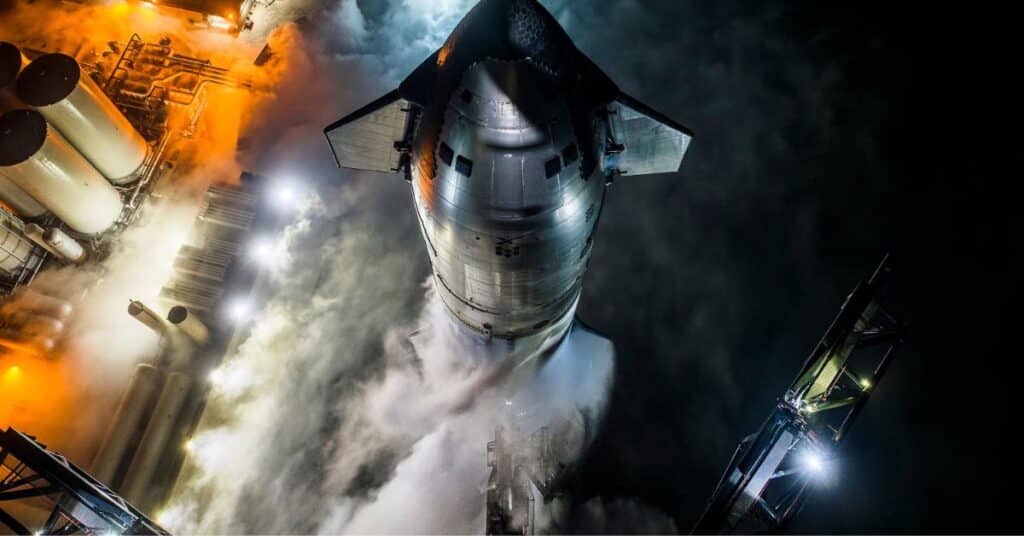
SpaceX rolled out an upgraded version of its Starship rocket booster at the company’s Starbase facility in South Texas on Thursday, marking the start of testing for what it calls the “V3” model. However, just hours later, during early test operations, an explosion rocked the site, causing visible damage to the lower section of the booster.
According to live streams and videos shared by local space watchers, the incident occurred around 4:00 a.m. local time on Friday. Footage captured a sudden flash originating from the base of the booster, followed by a plume of smoke rising into the night sky. Photos taken shortly after show a large gap torn open in the side of the rocket’s lower section.
This explosion differed from previous fiery mishaps SpaceX experienced in earlier Starship testing phases. While past failures often involved complete destruction, this time the majority of the booster remained upright. Notably, the booster had not yet been fitted with Raptor engines, suggesting the issue may have been linked to structural or pressurization systems rather than propulsion.
SpaceX confirmed that the explosion took place during “gas system pressure testing,” emphasizing that no one was injured since personnel had cleared the pad before the test. In a statement on X, the company said teams had begun investigating the cause and would take time to fully understand the failure before resuming further testing activities.
The new Starship V3 represents the next leap in SpaceX’s spacecraft design. It features upgraded materials, improved structural components, and greater payload capacity. The company aims for V3 to support on-orbit docking between Starships, a fundamental capability required for future Moon and Mars missions under NASA’s Artemis program and SpaceX’s own interplanetary goals.
This setback comes at a pivotal time for SpaceX, which recently wrapped the final flight of its Starship V2 model in October. The transition to V3 is key to achieving full reusability and sustained deep-space transport. Any prolonged investigation or repair period could delay the sequence of scheduled tests leading to the next orbital launch attempt.
Despite the explosion, analysts believe SpaceX’s iterative approach—testing, failing, and rapidly improving—remains its strength. Engineers are expected to analyze pressure data and material fatigue points from this event to refine future prototypes. Industry watchers note that SpaceX’s resilience through similar obstacles has repeatedly turned setbacks into crucial learning milestones for its ambitious spaceflight program.
SpaceX rolled out the next generation of Starship to Masseys for testing, but during a routine ambient-pressure test, the Liquid Oxygen Tank ruptured.https://t.co/xkz1PgvKPA
— NSF – NASASpaceflight.com (@NASASpaceflight) November 21, 2025
By Ryan Weber (@rweb11742).
